
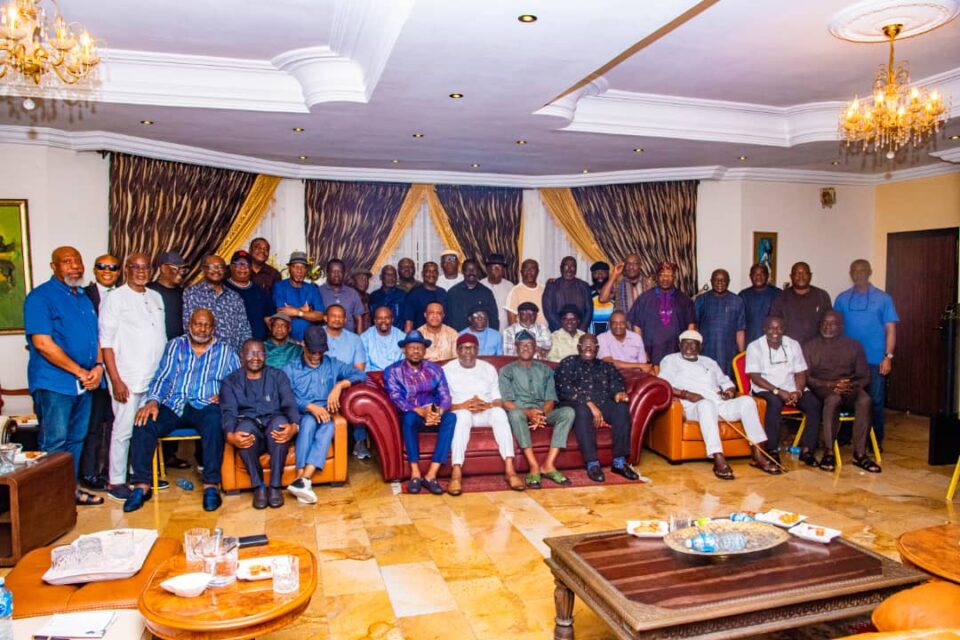
FUBARA’S MEN ABSENT AT GOV’S REUNION WITH WIKEH.
Port Harcourt | October 5, 2025
A high-profile reconciliation meeting between Minister of the Federal Capital Territory, Nyesom Wikeh, and Rivers State Governor Siminalayi Fubara on Saturday produced more questions than closure, not because the principals failed to show, but because a noticeable tranche of Governor Fubara’s closest political aides and loyalists were absent from the gathering, prompting fresh speculation about the depth and durability of the thaw.
Governor Fubara met with Minister Wikeh and several Rivers elders and notable politicians at the Port Harcourt residence of elder statesman Chief Ferdinand Alabraba in what officials described as a reconciliatory session aimed at consolidating peace in the state after months of political rancour.
Photographs and multiple reports show Wike and Fubara together, alongside a number of senior figures, but several of the governor’s known close allies were noticeably missing.
Local outlets and on-the-ground sources reported that the meeting stretched into the early hours of Sunday and was closed to the press; organizers described the gathering as part of a continuing process to restore unity to Rivers State’s fractured political family.
Photographs published alongside news stories identified attendees including Chief Ferdinand Alabraba and members of the Rivers State Elders Council; Channelstv and Punch named Speaker Martin Amaewhule among those present.
At the same time, several well-known figures associated with Governor Fubara’s inner circle did not appear in official photos or lists released after the meeting, an absence which some observers within the governor’s camp described to reporters as “awkward” and a cause for The Wike–Fubara relationship has been under intense strain since soon after Fubara’s emergence as Rivers governor.
The feud widened in early 2025 and produced an extended political crisis in the state, drawing federal attention and interventions.
Reporting earlier this year documented scenes of pleas for reconciliation, including an April visit by Fubara to Wike’s Abuja residence described by one outlet as an effort to seek peace.
The crisis previously resulted in extra-ordinary federal involvement and widespread reshuffling of state political alignments.
That history makes any signal from a public meeting politically freighted: a genuine, broad reconciliation would normally include both principals and their lieutenants; a meeting with principal actors but without a complement of customary lieutenants raises questions about either internal mistrust, ongoing negotiations over portfolios, or rival power centres within the governor’s camp.
A senior source close to Fubara told reporters the governor had attended to demonstrate commitment to peace but had intentionally limited the guest list to senior elders and a small number of political heavyweights, a move the source described as “deliberate and tactical”, aimed at avoiding public grandstanding while talks continue behind closed doors.
Another insider cited by Punch said members of the governor’s camp were “anxious” at photographs showing the governor without his usual close allies and asked why they had been excluded from the meeting.
That sense of unease was echoed by a handful of local politicians who worry that exclusion from key reconciliatory talks could translate to loss of influence.
Wikeh, appearing relaxed in published images and video, later described the engagement as part of ongoing efforts to preserve stability and urged parties to prioritise the welfare of Rivers people over factional disputes.
Since the crisis began earlier in 2025, a series of closed-door meetings and staged reconciliations have often preceded formal announcements.
Limited attendance at early reconciliatory sessions is not unprecedented, leaders have historically used smaller groups to hammer out initial terms before inviting wider camps.
When a reunion is negotiated without key lieutenants, it can either indicate that the principal is acting independently of a faction or that negotiations are at a delicate stage where showing all cards could jeopardize a deal.
Both interpretations are consistent with the pattern of elite bargaining observed in previous Rivers political disputes.
Political analysts and local elders contacted by regional outlets suggested three likely pathways:
1. Broad reconciliation: The principals might use the smaller meeting to reach first-stage agreements, then publish a larger, inclusive reconciliation once terms on appointments, committees or legislative business are agreed.
2. Managed truce: The meeting may produce only a superficial détente, enough to quiet immediate tensions while deeper disagreements about power sharing remain unresolved.
3. Renewed factionalism: Exclusion of key loyalists could harden positions inside Fubara’s camp, producing fresh maneuvering that could complicate governance and legislative cooperation.
These scenarios reflect the fragile balance of political incentives in the state and the high stakes attached to patronage and control of state structures.
Residents and civil society actors interviewed by local reporters welcomed any sign of a return to peace but warned that reconciliation must translate into better governance, service delivery, security and prompt remittance of workers’ salaries, to have real public value.
Several community leaders called for transparency in the settlement process, arguing that closed-door deals that leave broad constituencies out risk sowing new grievances.
Saturday’s reunion between Governor Fubara and Minister Wike is a meaningful development in Rivers politics, but the conspicuous absence of several of Fubara’s known loyalists from the event complicates the headline of “reconciliation.”
Whether the meeting marks the start of a durable peace or merely an elite-level pause in hostilities will depend on whether the principals can broaden participation, publish clear agreements, and critically translate any accord into improved governance for Rivers people. For now, observers say the handshake is necessary but not yet sufficient.
This News Is Reaching You From Ogulaha Vanguards Ltd.
The True Face Of Niger Delta.
We Tell Your Story Better.
