
Fubara Consults Tinubu on Rivers Peace Sustenance
Port Harcourt|
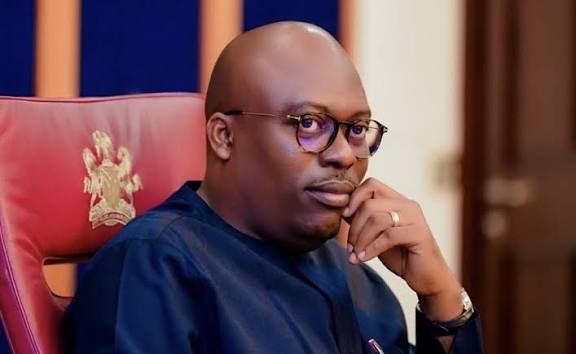
Rivers State Governor, Siminalayi Fubara, has sought the intervention of President Bola Ahmed Tinubu in consolidating peace and stability in Rivers, barely a week after his reinstatement following a six-month suspension triggered by the state of emergency declared in March 2025.
Governor Fubara visited the Presidential Villa, Abuja, yesterday where he held a closed-door meeting with President Tinubu to discuss strategies for sustaining peace in Rivers State, a region recently rocked by political turbulence, legislative crisis, and violent unrest in waterfront communities.
Rivers State has long been a theatre of political power struggles in Nigeria’s Fourth Republic. From the bitter face-off between Governor Peter Odili and his opponents in the early 2000s, to the violent clashes during Rotimi Amaechi’s tenure, and more recently, the rift between Fubara and his predecessor, Nyesom Wike, the state’s politics has often teetered on the edge of conflict.
In March 2025, President Tinubu invoked constitutional powers to declare a state of emergency in Rivers, citing breakdown of law and order. Both the Governor and House of Assembly were suspended, with an Interim Administration installed to manage affairs. The move sparked debates across the country, with constitutional lawyers questioning its legality.
Last week, following the expiration of the emergency rule, both Governor Fubara and the Assembly were reinstated. Analysts say the governor’s decision to consult Tinubu is aimed at preventing a relapse into chaos.
Speaking to reporters after the meeting, Fubara said:
“Peace is not just the absence of crisis; it is the presence of justice and good governance. I came here to brief Mr. President on the realities on the ground and to seek his continued support in consolidating peace and reconciliation among Rivers people.”
Dr. Uche Igwe, a political analyst, described the move as “timely and strategic.”
“The governor is aware that the political environment in Rivers is fragile. By seeking Tinubu’s backing, he signals his commitment to peace-building. But sustaining peace will require genuine reconciliation, not just elite negotiations in Abuja,” Igwe noted.
Community leaders in Port Harcourt waterfronts, where much of the violence erupted earlier this year, expressed cautious optimism. Mr. Dawari Johnson, a leader in one of the waterfront communities told our correspondent:
“Our people suffered displacement and loss during the crisis. We welcome the governor’s outreach to Abuja, but peace must trickle down to ordinary communities. It is not about politicians alone; it is about our survival.”
Under Section 305 of the Nigerian Constitution, the President may declare a state of emergency when there is clear breakdown of law and order. However, many argue that the Rivers episode tested the boundaries of federal power over subnational entities.
Prof. Ebere Okonkwo, a constitutional lawyer at the University of Lagos, explained:
“Fubara’s reinstatement shows that emergency rule was meant as a cooling-off period. His consultation with Tinubu signals a federal-state partnership to avoid relapse, but it also underlines the growing debate on how far Abuja can go in state politics.”
The presidency has yet to release details of the meeting, but insiders suggest discussions touched on reconciliation between factions in the Rivers House of Assembly, security arrangements, and measures to restore confidence in governance.
For now, residents of Rivers are hopeful that the renewed dialogue between Port Harcourt and Abuja can finally bring the state out of its cycle of political crises.
