
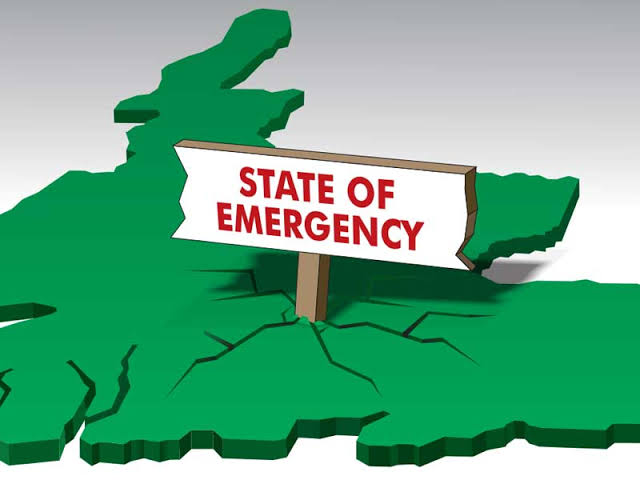
State of Emergency in Rivers State: A Constitutional Aberration or a clear demonstration of priorities?
In the 17th Century, the people who colonized our country were holding debates about the role and authority of their Constitution.
As we learn from Professor William Pettigrew, they were asking if “the legitimacy of the English state ought to derive from the crown or from the subjects of the crown?”
On March 18th of this year, four centuries after the fact, Nigerians were left asking a similar question: wherein lies the power that undergirds our legal parameters? Or, who can decide what the Constitution says, what it constitutes?
On that fateful day, the nation’s President, Mr Bola Tinubu, declared a state of emergency in Rivers State.
He alleged that the political infighting generated by disputes between the former governor – and current minister to Tinubu Nyesome Wike – and the current governor Siminalayi Fubara had reached a deadlock.
According to the President, Rivers State had stopped working for its citizens since the current governor was ruling like a dictator, and he, as the president, as the fadas of all fadas, the oga pata pata of the country, had to put a stop to it.
This was an altruistic act, he told us, in favor of all nigerians.
The issue is that none of that reasoning can be found in the text of our constitution: in that document that, as the name already advances, is meant to constitute a community of and in law; in that document where the power of the President is explicitly laid out, where the notion of emergency is somewhat outlined. But none of that seemed to matter to Tinubu.
Indeed, one of the major issues raised by legal luminaries across the county was that the Nigerian Constitution does not grant the president the power to dissolve or suspend an elected official under the guise of a state of emergency. Such an action, they argue, undermines democratic principles and sets a dangerous precedent for future governance in the country.
The rule of law, per their understanding, rests on paying close attention to what instituted powers are explicitly allowed to do. Otherwise, we enter uneasy territory, a territory once traversed by our military past.
That is the reason, they affirm, that we should try as much as we can to stay away from frivolous executive decisions.
But the constitution they speak of, this beautiful body of laws and regulations supposedly crafted by our representatives does not seem to be constituting any longer. It has been undressed, undone, first as tragedy, then as comedy.
In our scenario, the head that wears the crown is not uneasy, as it should be, and, rather, has become unseemly.
The recent declaration of an emergency has allowed us to think, and in thinking, to dream (why not?). It has made me think of another world and of that word emergency.
What does and what could it mean for us, here, in Port Harcourt, the capital of Rivers State? What could this power that is no longer constituting be missing when it speaks of and in the name of emergency?
In the past two years, for instance, the sudden increase in the price of fuel led many families to incredible debt. Due to its connection to multiple and various value chains, the price of foodstuffs soared beyond the reach of the average resident. Staple items such as rice, beans, garri, and cooking oil became luxuries for many households.
The reason for this sudden increase was a governmental decision: Tinubu decided to remove the fuel subsidy that escalated the cost of living for millions of Nigerians. He argued it was important to let market dictate the ‘real’ price of fuel and, in turn, of essential commodities.
The correct price, after all, would allow for a precise and fair allocation of resources. So he argues.
But, I ask, what happens when the correctness of the market means that millions of people can no longer pay rent, school fees and put food on their tables? Would this not constitute an emergency?
Would it, then, be feasible to declare a state of emergency against these forces of impoverishment?
Here in Port Harcourt, we have seen that Tinubu’s policies have been terrible for small and medium-sized enterprises (SMEs).
In fact, many are collapsing. One of the reasons is the high cost of running diesel-fueled generators.
Some vendors, desperate to maintain their businesses, have even attempted to adapt their generators to different fuel systems, with dire consequences. The need for generators, in turn, is due to a national grid that has collapsed at least nine times in the past year.
A grid so faulty that it is responsible for many of the fires that destroy our properties and even markets in our communities in Port Harcourt. Are the lack of reliable basic services not an emergency? Are the continuing reduction of jobs, deepening economic instability, and destruction of our immediate environment not more important than a fight between an overfed Godfather and his Godson? Apparently not.
Unfortunately, the emergencies I see, and experience everyday don’t end there. Today, residents of Port Harcourt live in constant fear.
First, because of the rising cases of armed robbery, kidnappings, and cult-related violence.
A violence that is predicated on the inadequacy of security forces. In these cases, if one has an emergency, very little can be done, and no part of the state is reliable.
Second, because the healthcare facilities in Port Harcourt are overwhelmed, underfunded, and poorly equipped, especially the public health centres. Rising medical costs mean that many citizens cannot afford basic healthcare services, and the shortage of essential drugs and medical personnel has led to increased mortality rates.
As we, the people who have to navigate these emergencies every day, know: preventable and curable diseases have lead to deaths in Nigeria because of the inadequate intervention from authorities. In our city, if someone has a medical emergency, almost nothing is reliable.
House rent prices in Port Harcourt have skyrocketed within a year. A one-bedroom apartment that once cost between ₦300,000 and ₦400,000 now goes for ₦700,000 to ₦1.5 million in some areas.
With salaries remaining stagnant or seeing only slight increases for the lucky few with jobs, many are struggling to keep up. For those without employment or a stable business, the situation is even more critical. How will citizens cope when their recurring expenses outweigh their income?
The combined effect of these crises has reduced the quality of life in Port Harcourt. The economic hardship, insecurity, and lack of access to basic services have pushed many residents into extreme suffering, especially those living in underserved communities.
Urgent intervention is needed to prevent total societal breakdown. Yet, none of these issues, none of the immediate, urgent, concerns of the people of Rivers State are worthy of our President, our policies, and even our Constitution.
In my dream, a dream I dream collectively with many waterfront residents across this city, government should prioritize addressing the real issues plaguing the state – food insecurity, healthcare and housing deficiencies, violence, transportation costs, unemployment, and poverty.
If there is to be any declaration of emergency, it should be in these areas, where immediate intervention can have a meaningful impact on the lives of the people. Anything short of these is a political move that does more harm than good to the people of the state.
The plight of Port Harcourt residents should not be ignored. The time for decisive action is now to restore hope, stability, and prosperity to the people.
OGULAGHA VANGUARDS NEWS
