
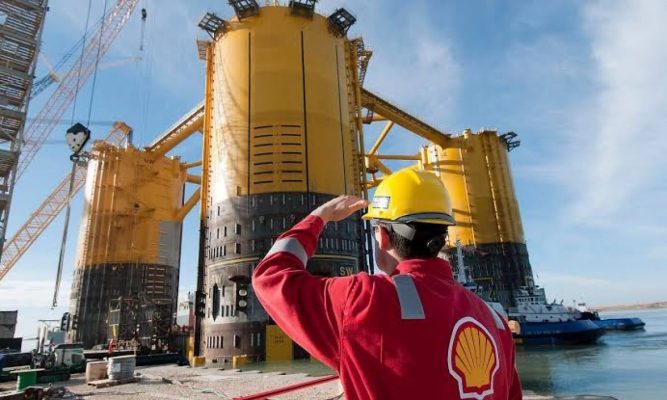
Benefit for Nigeria as regulators approve Shell’s $1.3 billion asset sale
.. awaiting approval from Tinubu as minister of petroleum
Shell International Plc’s offer to sell Renaissance its onshore assets for $1.3 billion has been approved by the Nigerian Upstream Petroleum Regulatory Commission (NUPRC).
As required by the Petroleum Industry Act (PIA), the regulatory commission has approved the sale of Shell’s 75-year-old onshore assets to Renaissance, a group of four Nigerian exploration and production companies and an international energy group. Senior government sources confirmed this to BusinessDay.
If this agreement goes through, it should strengthen Nigeria’s oil output, enhance government gasoline revenue, strengthen the naira, and expedite government ambitions for gas development.
But President Bola Tinubu, who also serves as the minister of petroleum resources, must still give his final assent to the agreement.
“NUPRC has approved the sale and made the recommendation to the minister of petroleum for approval. This is on the minister’s table. All ‘next steps’ await the minister’s consent,” a senior government source said.
“As you know, the minister, who doubles as president, has been out of the country,” stated a second senior government source. The minister’s permission is still pending, therefore all subsequent actions, including statutory payments, must wait.
The British energy giant pioneered Nigeria’s oil and gas business beginning in the 1930s. It has struggled for years with hundreds of onshore oil spills as a result of theft, sabotage and operational issues that led to costly repairs and high-profile lawsuits.
Shell in January announced that it had reached an agreement to sell its onshore assets in the Niger Delta region to Renaissance and focus on deepwater and integrated gas investments.
The purchaser, the Renaissance consortium, is made up of Petrolin, a trade and investment firm with headquarters in Switzerland, as well as ND Western, Aradel Energy, First E&P, Waltersmith, and other regional oil exploration and production firms.
Sources said Shell executives have promised to assist in speedily developing Bonga assets, support an increase in oil production and accelerate the government’s plans for gas development if the Shell/Renaissance deal sees the light of the day.
“They want to put $7 billion down to develop Bonga and in three years help local operators develop an additional 300,000 barrels per day (bpd) to 500,000 bpd. They also want to stake partnership to ensure that the gas part of the deal is quickly done to benefit Nigeria,” one of the senior government sources told BusinessDay.
As of the time of publishing these reports, attempts to get in contact with Olaide Shonola, the NUPRC’s head of public affairs, through phone calls or mails have been unsuccessful.
Implications for Bonga
The agreement is expected to revitalize Nigeria’s oil and gas industry, but analysts are closely monitoring how it can affect Bonga’s development and production goals.
The Nigeria Liquefied Natural Gas (NLNG) plant in Bonny is fueled by the 225,000 barrels of crude oil and 150 million standard cubic feet (scf) of gas that Bonga, the country’s first deepwater oil well, can currently produce daily.
It was anticipated that the development of Bonga Southwest will increase Nigeria’s oil reserves by about 1 billion barrels. With a potential production of 3.2 billion barrels, Shell has previously stated that it will develop the Bonga Southwest project over the course of three phases.
According to representatives of the Nigerian National Petroleum Company (NNPC), one of the initiatives Nigeria was counting on to boost production to over 3 million bpd by 2023 was the field’s output.
Nigeria, which produces high-quality light sweet crude oil, has seen its production slump to multi-decade lows, due to operational, technical and sabotage issues.
Nigeria can pump around 2.2 million bpd of crude and condensate but output languished near 1.3 million bpd in July 2024, according to NUPRC’s estimates.
The Bonga Southwest’s concessionaire, NNPC, has estimated that the project will cost $10 billion to develop.
According to NUPRC estimates, Nigeria can produce over 2.2 million barrels per day of crude and condensate, but in July 2024, output stagnated at about 1.3 million barrels per day.
The Bonga Southwest’s concessionaire, NNPC, has estimated that the project will cost $10 billion to develop.
The majority of Bonga Southwest’s resources are found in OML 118, but it also reaches OMLs 132 and 140, which are run by US major Chevron and are known as Aparo. TotalEnergies of France and Eni of Italy are other project partners.
Assets at stake for divestment
According to Shell, the agreement is set up to ensure that Shell Petroleum Development Company of Nigeria Limited (SPDC) can continue to support the SPDC Joint Venture (SPDC JV) through its operational skills.
The SPDC JV’s operational assets are: 250 producing oil wells (189 West and 61 East); 37 producing gas wells (4 West and 33 East); four gas plants; and two onshore oil export terminals, according to data taken from Shell Nigeria’s Briefing Notes 2023.
Other partners in the SPDC JV include: the NNPC (55 percent), Total Exploration and Production Nigeria (10 percent) and Nigeria Agip Oil Company (5 percent).
As part of the transition, SPDC’s employees will remain with the company under the new ownership.
Shell’s 25.6 percent interest in Nigeria’s Liquefied Natural Gas (NLNG) plant is not included in this transaction.
Shell’s presence in Nigeria will still be significant post-sale, with three businesses that will also remain outside the scope of the deal.
These include Daystar Power Group, which provides solar power solutions throughout West Africa; Shell Nigeria Exploration and Production Company, which operates in the deepwater Gulf of Guinea; and Shell Nigeria Gas, which sells gas to nearby businesses and commercial customers.
Win for Indigenous companies
Several of Nigeria’s most reputable upstream businesses, which have a track record of revitalizing established Niger Delta assets, are members of the Renaissance consortium.
Every shareholder in Renaissance has individually proven to be capable of conducting business in Nigeria and maximizing local wealth development. Around Ogbele, Aradel Holdings has developed an integrated oil, gas, and refining company that has evolved over time.
Waltersmith operates the Ibigwe modular refinery and the producing Ibigwe marginal field similarly. In 2020, First E&P effectively launched the Anyala-Madu shallow water hub, and it is currently collaborating with Dangote to shortly produce the first oil at the Kalaekule Field.
Implications for Nigeria’s gas ambitions
In order to achieve the goals of the “Decade of Gas,” which aims to increase gas penetration and create a more sustainable and industrialized gas-based economy, Nigeria must overcome the existing lack of gas supplies.
Renaissance will become an essential partner for the public and private sector entities looking to develop Nigeria’s gas value-chain and a cornerstone of the nation’s gas monetisation plan as it works to increase gas production, processing, and distribution.
Hence, it is noteworthy that Tony Attah, a former Shell executive and managing director/CEO of Nigeria LNG for over five years, was named Renaissance’s first MD/CEO.
This News Is Reaching You From Ogulagha Vanguards Ltd
The True Face Of Niger Delta.
We Tell Your Story Better
For Publication Of Press Releases, Statements, Advert And Inquiries Send An email To ogulaghavangurds@gmail.com
Call 08051670922 , Or, Reach Us At,
www.ogulaghavanguards.com.ng
